GATT
A 3D Animated Series
A 3D Animated Series
GATT is a 3D animated space western sci-fi that takes the tone and atmosphere of Marvel's Guardians of the Galaxy and pairs it with the structure and themes of Shonen Jump's One Piece. It follows a crew of superhuman bounty hunters hopping from planet to planet in their escape as fugitives under the law, all while liberating those they encounter from the clutches of oppression in whatever form it manifests.
As an entry in the space western genre, GATT blends the chaotic lawlessness of an economy steeped in the bounty system with the sense of discovery granted by the final frontier of space, set amidst the backdrop of escalating civil war tensions.
This burgeoning powder keg, spurred on by organized space pirates (forced to live on the outskirts of society) and groups of marginalized citizens (grappling with the inherent distrust of a technocratic, authoritarian regime ruling over vast portions of the known galaxy), becomes the perfect catalyst for human drama to emerge, exploring themes of generational trauma, individualism in the face of suppression, and a greater sense of community: the idea that people need one another, even in an environment that rewards constantly looking over one's shoulder.
The potential for this kind of narrative to inspire change and a wider discussion of contemporary issues is the overall goal and purpose of this project. As a studio, we strive towards the greater awareness of Unreal Engine’s potential as a powerful tool for multimedia projects beyond gaming, especially when utilized in tandem with other free resources like Blender and Sketchfab. Through our success, we hope to inspire other young creatives to pursue their artistic inclinations through Unreal Engine 5 by showcasing what can be achieved with little to no budget and a community’s worth of effort.
In 2022 we released a 36-minute pilot episode created in Unity Engine, which we intend to remaster this summer in Unreal Engine 5, as we believe the engine offers far more robust tools for real-time film-making.
The team is led by Rigved Deshpande, a former Blizzard technical artist with experience shipping AAA titles. His creative partner, Alfonso Vaca, is the only writer on the project, and his near decade of experience with professional screenwriting software has allowed for seamless coordination between the team and over 10 collaborating voice actors and musicians, fostering an environment for effective collaboration while working remotely during and past the pandemic.
Episode 1 premiered with a live viewing in virtual reality on the Spatial platform. Over the course of the evening 60+ people tuned in on their phones, PCs and VR headsets, making it the most popular space that night.
We believe in giving back: all 3D assets created during production will be released free on SketchFab, and all pipeline tools built with the Blender and Unreal Python APIs will be open-sourced on GitHub.
We use Sony's Mocopi Sensor Kit to record motion capture performances streamed directly to our Unreal Metahumans using the Live Link plugin and Take Recorder.
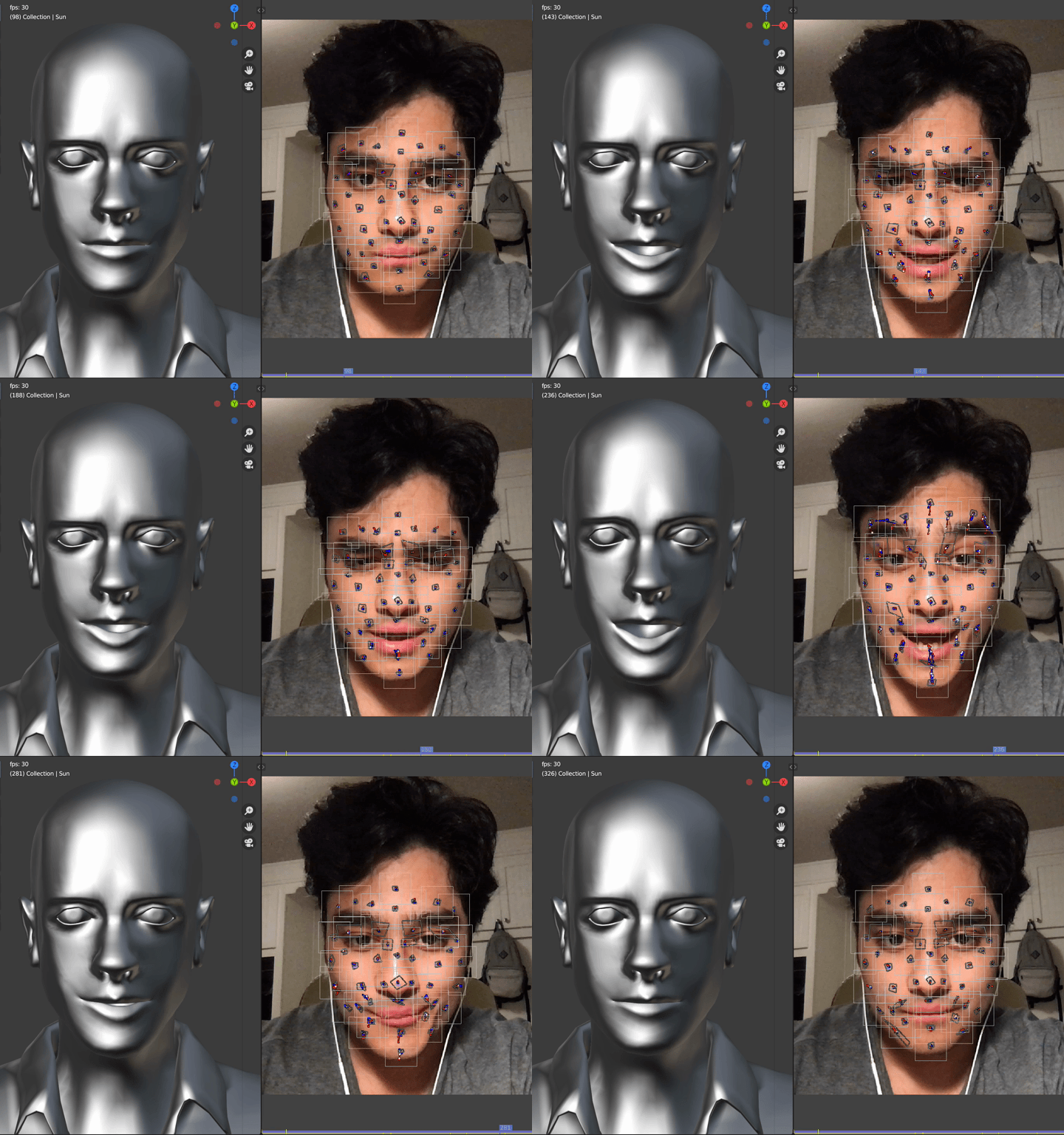
We use a variety of computer-vision techniques to capture authentic facial performances for our characters within Blender and Unreal.
We author most of our assets in Blender because it is free and open-source for all our artists, and leverage the Blender Python API to script custom tools to expedite their workflow.
Our character creation process involves creating a Metahuman character in Unreal as a base, and then sculpting its features in Blender to create our unique Western anime aesthetic. The result after assembly? A stylized character with all the facial and body controls of a Metahuman.
We find hand-painted textures yield the best results under our stylized cel shaded post processing. Using a pen and stylus within Blender and Krita allows us to put the utmost care and detail into the textures we produce.
Unreal offers the exciting opportunity to work with gaming technology while following a film industry-standard triphasic production timeline.
| Pre-Production | Production | Post-Production |
|---|---|---|
|
Storyboard Instead of a conventional 2D storyboard, we use primitive geometry and basic camera placement in Unreal itself to make a 3D storyboard. A 3D storyboard enables us to "walk" the virtual space and come up with interesting angles and compositions, as well as make adjustments based on any feedback received. Furthermore, creating a 3D storyboard already completes most of the layout work needed later on when assembling the scene. Character Assets We have already created our core cast of characters; however every episode introduces side characters which entails designing a new Metahuman, outfit asset and groom. Environment Assets We start with a KitBash and adapt it to the world of GATT by adding on sci-fi elements. Any environment assets we cannot source via online marketplaces we generate using multi-modal 3D AI models such as Microsoft's Trellis. This is an advantageous and time-effective approach since the majority of environment assets don't need to be rigged or deformed. Layout Once all character and environment assets for an episode have been prepared, we create Level Sequences which place each asset in the correct location along with some rudimentary placeholder animations to indicate how they will move and perform in each scene. Playing back these sequences results in a 3D animatic which dictates how production stage animation will be implemented. |
Motion Capture A final animation list is obtained from the pre-production animatic and then performed through our motion capture workflow, which is then refined and retargeted within Unreal Engine to deliver the final animation. Voice Acting We schedule virtual acting sessions over Zoom with our team of voice actors, using both their recorded audio performances as well as passing their video feed through the Live Link plugin in Unreal to transfer their facial movements to our Metahuman characters. |
Editing The final cut for each episode is made in Blender using some open-source video compositing plugins. Each sequence from Unreal is rendered out as a frame sequence and stitched together in Blender. Soundtracks The music for each episode of GATT is produced externally by the musicians we partner with and layered with great care and intention in Blender to create our desired space western atmosphere. |
Combined production time for each episode: 4 months
We will release the remastered pilot episode of GATT in June 2026, with episodes 2 and 3 following thereafter in October 2026 and February 2027. The first narrative arc of GATT is self-contained and told completely within the first 5 episodes, and the first season will contain 11 episodes in total.